
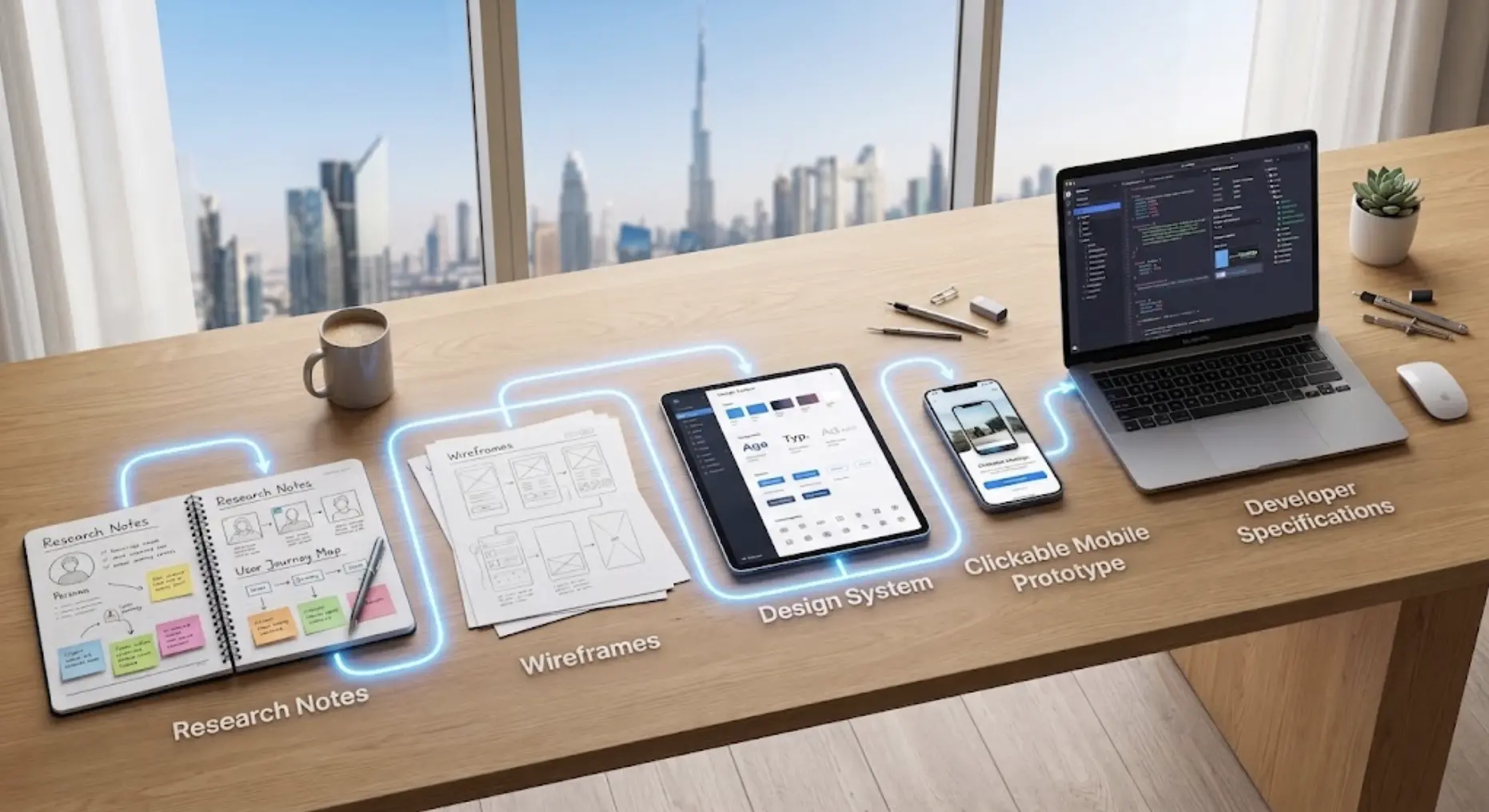
UI/UX proposals have a habit of making ordinary words sound mysterious. Discovery. Architecture. Ideation. Handoff. Everyone nods, the project begins, and three weeks later somebody quietly asks when the actual screens are coming.
A typical project for ui ux design services in Dubai should explain what each phase produces, who is involved, and which decisions must be made before the next phase begins. The screens matter, obviously. They are simply not the first useful thing the team creates.
Discovery defines the problem worth solving
The project usually begins with business goals, user groups, success measures, technical constraints, existing data, stakeholder expectations, and the realities of content. This is where the team separates a genuine user problem from an internal preference wearing a serious expression.
The research and workshop phase may include stakeholder interviews, analytics review, competitor analysis, user interviews, journey mapping, and collaborative workshops. Not every project needs every method. A credible ui ux design company in Dubai chooses the research needed to reduce the riskiest assumptions rather than performing research theatre.
Information architecture makes the experience findable
Before designing screens, the team decides how information and tasks are organised. That can include a site map, navigation model, content hierarchy, user flows, feature priorities, and the relationship between different user roles. It is the quiet structural work that stops a polished interface becoming a beautifully signposted maze.
Stakeholders should be able to review the main journeys here. Can a first-time visitor understand the offer? Can an existing customer reach a frequent task quickly? Can the business support the promised content and features after launch? Solving these questions in diagrams is cheaper than discovering them inside finished designs.
Wireframes focus the conversation
Wireframes show layout, priority, content blocks, and interaction without the distraction of final colour, photography, or typography. They help teams agree what belongs on each screen and how users move through it. Low-fidelity work is not unfinished design. It is a deliberate stage for making structural decisions.
The scope should say which journeys are wireframed and at what level of detail. A marketing website may need a set of representative page templates. A complex product may need complete flows for onboarding, permissions, errors, empty states, and repeated tasks. ‘All screens’ is not a scope until someone has defined what all means.
UI design turns the structure into a recognisable brand experience
Once flows are stable, the interface layer establishes typography, colour, spacing, components, imagery, icons, states, and responsive behaviour. A good ui ux design services company does not paste the brand palette onto wireframes and call it UI. It creates a visual system that supports hierarchy, accessibility, trust, and character at the same time.
For larger products, expect a component library or design system with reusable patterns and documented states. That investment improves consistency and makes future features faster to design and build. It also prevents every new button from becoming a small philosophical debate.
Prototypes make the experience testable
A clickable prototype delivery links key screens so stakeholders and users can experience important journeys before development. It may simulate navigation, forms, menus, transitions, and decision points. The prototype is not the finished product, and it usually does not contain real data or production code.
The scope should identify which flows will be prototyped and whether usability testing is included. Testing may involve a small number of representative users completing realistic tasks while the team observes confusion, hesitation, and workarounds. Five polite approvals in a boardroom are not a substitute for one customer getting genuinely lost.
Developer handoff is a process, not a file link
The developer handoff process should provide final designs, component behaviours, responsive rules, assets, content, annotations where needed, and access to the design system. It should also include time for developers to ask questions and for designers to review the implementation.
Clarify whether the design team supports development, checks staging, documents edge cases, and approves visual quality before launch. Without that collaboration, tiny interpretation gaps accumulate. The result can be technically correct and still feel like the design passed through a photocopier.
Know what may sit outside the scope
Brand strategy, copywriting, translation, photography, illustration, development, data migration, accessibility certification, extensive user recruitment, and post-launch optimisation may be separate services. None of that is a red flag. An unexplained assumption is.
A good proposal states the number of workshops, templates or screens, revision rounds, prototype flows, testing sessions, and handoff support. It also explains what happens when the product grows during the project, as products tend to do the moment everyone sees the first convincing screen.
Why Choose Steleo?
We take UI/UX projects from research and structure through interface systems, prototypes, testing, and development-aware handoff. Our approach is practical, collaborative, and particularly suited to brands that need complex information to feel simple.
If you want to know exactly what the design team will do before the first screen appears, talk to us. We will make the scope as clear as the experience we intend to create.
